


 Photos - John Sones
Fiercely independent Lithuanian theatre company OKT/Vilnius City Theatre (OKT), established as OKT by its director and artistic director Oskaras Korsunovas in 1999, has brought a daring interpretation of Shakespeare's Romeo and Juliet to this year's Melbourne International Arts Festival; a version that both challenges and entertains.
It takes a brave director to dare to create their own take on any work of Shakespeare. Some have done it with great success. Japanese director Akira Kurosawa proved how well it can be done with his 1957 film Throne of Blood based on Macbeth but set in medieval Japan, with virtually no Shakespearean dialogue. The great tragic love story, Romeo and Juliet, has been re-created as a stage musical West Side Story (1957 - Arthur Laurents, book; Leonard Bernstein, music; and Stephen Sondheim, lyrics) and a 1961 film directed by Robert Wise; both set in Manhattan's West End and focusing on two warring gangs, one white, the other Puerto Rican. More recently we have seen Baz Luhrmann's film Romeo and Juliet (1996), an interpretation which retains much of the Shakespearean language but has the warring families as competing business empires, who fight it out with guns rather than swords.
OKT's version of Romeo and Juliet is spoken in Lithuanian with English surtitles. This inevitably places an additional demand on the audience members, most of whom can be expected not to speak the language. Whilst many may be disappointed at not hearing the poetry of Shakespeare, OKT's Romeo and Juliet is an exciting and satisfying theatrical experience. The staging and the performances quickly ensure that the audience is caught up in, and moved by, the drama that unfolds before them with its timeless themes of the self-defeating, futile and ultimately destructive rivalry that may become entrenched within any society; the inevitable competition between young men anxious to demonstrate their sexual prowess and superiority over each other; and the passionate depth and excesses of teenage love.
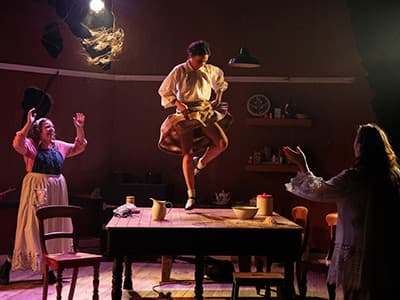
Contemporary dress and music firmly place the action in the 1960s with the Montagues and the Capulets owning rival pizzerias! The set consists of two pizza kitchens, complete with ovens, tables, implements and condiments – flour and dough being frequently used to creative and hilarious effect. The two kitchens are separated by a narrow aisle down which a large round metal cauldron, or flour bowl, is from time to time trundled up and down - the mixing bowl?
The play opens with the 15 member cast filing in and lining up across the front of their kitchen. They stand in silence, staring out at the audience. The lengthy silence prompts some sporadic laughter from the audience and then the stage erupts in a fury of sound (loud electronic music) and frenetic action. Pushes and shoves lead to a full on fight. Pizza dough and flour fly around the set. The elders intervene to try and calm the young men. The music changes to the cheesy 60s hit Tamure ... the dance of love. The two young men who were in the thick of the fight respond to the reprimands of their elders like naughty little boys caught in the act and pretend to be friends: Montagues and Capulets have drawn their battle lines.
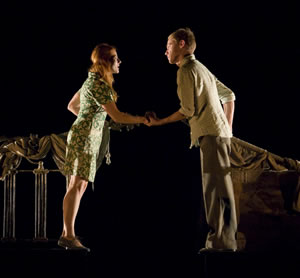
Energy and physicality are a mark of this production; and the sound effects and music underline and emphasise the humour, romance and ultimate tragedy. There are popular 1960s Italian-style hits such as Don't Forget Domani, lush, swelling, romantic music a la Korngold to background the love scenes, and crashes of thunder and flashes of lightning to herald the on-coming tragedy. The Balcony scene has Romeo (Gytis Ivanauskas) and Juliet (Rasa Samuolyte) on the rooftop of their respective kitchen, reaching across the gap to each other and is highlighted in golden light with romantic music swelling in the background, whilst from the darkness below issue snores and the sounds of dogs barking.
As the action moves inexorably towards the deaths of the lovers, lighting effects add an increasingly surreal edge to the scene, reminding me of the visual aesthetics of the 1991 French film directed by Marc Caro and Jean-Pierre Jeunet, Delicatessen, variously described as black comedy/romance/gothic. The final scene in the family crypt is effectively created by turning the pizza preparation tables on their ends, to the accompaniment of loud crashes of thunder and flashes of lightning, so that, brightly lit, they appear like gravestones standing out starkly against the dark background. The ghosts of Tybalt and Mercutio are present to watch over the lovers final moments. The final image of the dead lovers, sitting on the edge of the cauldron, leaning back to back against each other, beautiful yet so fragile, is truly memorable. As the play closes they crumple like faded flowers.
The two major protagonists are each delightful and believable in their naiveté and passion. Dainius Kazlauskas as Mercutio makes a meal of his role, especially when taunting, teasing and flirting with Tybalt (Darius Gumauskas) prior to the fatal fight and Egle Mikulionyte as Juliet's Nurse is a wonderfully, over-the-top, comic character. The other characters cheerfully join in the early mayhem and form a black-clad guard of honour at the end. Theirs is a true ensemble performance brought together by a firm directorial hand. OKT's Romeo and Juliet lives up to the expectations created by the company's reputation as an avant-garde group who are determined, in their own words, to search for a modern theatre language that corresponds with the rhythm of present life; that analyses the myth of a modern man and provokes the audience to see the possibility of other action or life.
This is not an easy night at the theatre, but then I like theatre that packs a punch and makes one think. Shakespeare's language may be special, it certainly is to me, but the themes of his plays are such, so basic to our human nature now as when they were written, that they lend themselves to re-interpretation. OKT's Romeo and Juliet brings a lively theatricality and a modern-day twist to a much loved classic.
Melbourne International Arts Festival presents
Romeo and Juliet
OKT/Vilnius City Theatre
Venue: the Arts Centre, Playhouse
When: Wed 22 Oct at 7.30pm
Thu 23 Oct at 1pm
Fri 24 & Sat 25 Oct at 7.30pm
Sat 25 Oct at 1pm
Duration: 3hr 30min with interval
Prices: Full $50 / Groups (8+) $45 / Conc $37.50 / Student/MF-Y $25
Bookings: Ticketmaster 1300 136 166 / www.melbournefestival.com.au